I've built antenna swarms, drilling models and a self-driving pool system. Now I build AI agents, and the thing
I care about most is whether you can trust them. Do they show their work, do they stay inside their
permissions, and do they actually get better every loop?
Founder, Portage
Former CTO, Corva
Founder, Clyr
Ph.D., Texas A&M
01 — Research goals
Agents you can actually trust.
The idea is simple. If an agent is going to do real work for a real business, I want to know what it did, where it
got it, and whether it was allowed to. That's agent reliability, evals and AI control, and it's where I spend my
research time.
Reliability
Can the agent show where its answer came from? I audit research agents for the stuff that quietly goes wrong:
claims with no source behind them, retrieval that missed half the picture, and gaps in the trace where nobody can
tell what actually happened.
Evals
Freeze the evidence, change one thing, run it again. I set up research benches where agents loop through dozens
of variations (tweak the MCP, tweak the guidance) and graders tell us if the output really got better. Then we
check it against a fixed reference and run it again to see if it holds.
Control
Agents shouldn't be running loose. They read and write through MCP endpoints, they inherit the user's
permissions and nothing more, the server enforces it, and anything risky goes back to a person to confirm.
Right now Running local models (Qwen, Ollama, OpenCode, MCP) through the same benches to
see where they break: semantic errors, context recovery, and whether they do the same thing twice.
02 — What I've built
Sense, decide, act, measure.
2026 —Portage FounderWe build agents for elite mid-market businesses. Think SEAL Team 6, not Accenture. Nightskye is
our control plane: it deploys Claude and Codex agents with versioned bundles, run records, scheduling and a person
watching. Our agents are doing real work today in mineral rights, tax-refund review and enterprise research.
2023 — 2026Corva Chief Technology OfficerLed ML for autonomous drilling in the Permian, from training base models all the way to
closed-loop control on the rig. We grew from $20M to over $75M in revenue while I ran technology.
2019 — 2025Clyr / Keto AI FounderBuilt a self-driving pool system: sensors in the water, software in the cloud, and the hardware
on the pad that actually controls the pool. Three granted patents. Exited to private equity in 2025.
2016 — 2019Arundo Analytics CTO · VP of ArchitectureGrew engineering from 5 to 70 people and built a big-data and ML platform for heavy
industry.
EarlierSiemens · Toshiba · Intel · ShipcomIndustrial automation, systems architecture and leading engineering teams.
B.S. · M.S. · Ph.D.Texas A&M University Electrical & Computer EngineeringComputer-vision beamforming for swarms, funded by the U.S. Army Research Office. Built Medusa.
12 Under 12 Young Alumni, 2016.
03 — What I believe
What I believe.
About Clyr
01 A pool should basically drive itself. Sensors in the water, automation
on the pad, and nobody babysitting the chemistry.
02 Remember these are pool guys. A tech should get through the whole visit
with a few pictures and their voice. No forms, no hunting for buttons.
03 Get to the step before the step. Alerts are reactive. I want the
leading indicator that tells you what's about to go wrong while you can still fix it.
04 Less is more. When the app turns into boxes in boxes, we pull it back
to the agent and a clean screen.
About AI
01 If an agent can't show me its sources, I don't trust the answer.
02 Permissions live on the server, not in the prompt. An agent gets the
user's access and nothing more.
03 Let the agents build autonomously. A person still says yes to anything
that matters.
04 Build the eval before you believe the demo. Fixed reference,
independent check, run it again.
About building
01 Close the loop. Antennas, drill bits, pool pumps, agents: it's always
sense, decide, act, measure, repeat.
02 It has to work end to end. If it only works in the demo, it doesn't
count.
03 Build it with off-the-shelf parts, put it in the real world and see
what breaks. The simulation never matches the chamber.
04 — Medusa
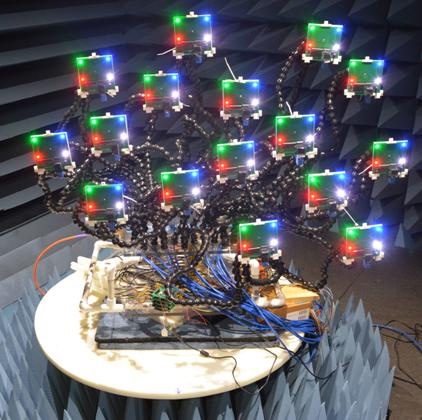
Medusa in the anechoic chamber, Texas A&M, 2015.
Sixteen arms, one beam.
Medusa was the testbed for my Ph.D.: sixteen antennas on flexible arms, which is how it got the name. A camera
with infrared depth sensing found every node and tracked it as the array changed shape, and the controller worked
out the phase each antenna needed so all their signals added up in one direction. It ran at 2.48 GHz on
off-the-shelf parts and boards I designed, and we measured it in an anechoic chamber.
The ripples on this page are sinc functions, sin(x)/x, which is the beam pattern of a
uniform aperture. Nothing shows up until the wave gets there. Same idea as Medusa.
A Framework for Computer Vision Assisted Beamforming in Aperiodic Phased Arrays
Drone swarms and mobile radios end up scattered at random, and scattered antennas can't work together unless
each one knows where it is. My idea was to use computer vision and depth sensing to find every node, track the
array as it moves, and hand those positions to a controller that steers the beam. Then I built it and compared
what we measured against the simulations.
Dissertation, Texas A&M University, December 2015. Committee chair: Gregory H. Huff.
Supported by the U.S. Army Research Laboratory and Army Research Office, W911NF-09-1-0429.